


.jpg)
For more than 30 years, the Hazard Analysis and Critical Control Points (HACCP) system has shaped food safety programs across the foodservice industry. But restaurant operations have changed. Multi-unit brands now need faster visibility, better accountability, and more reliable records than paper systems can provide.
For most restaurant brands, the question is no longer whether they have a HACCP plan. The real challenge is executing that plan consistently across every location, every day.
Manual food safety processes often create problems like these:
- Employees spend too much time filling out forms and collecting data
- Important checks are difficult to verify
- Records are only available on site
- Data is incomplete or unreliable
- Issues are only found during manual inspections
- Paper records are difficult to store and retrieve
These issues make it harder to maintain strong food safety controls, especially in multi-location operations.
Digital HACCP systems help solve many of these problems by improving visibility, reducing manual work, and creating more accurate records. Operators gain better monitoring, faster reporting, and easier access to audit documentation.
A better approach to HACCP
Many restaurant chains are replacing paper HACCP checklists with connected sensors, automated temperature monitoring, and restaurant operations software.
Digital HACCP systems give operators clearer records and better oversight. They also help provide the documentation regulators, auditors, and brand leaders expect, including:
- Proof of task completion
- Time stamps
- User identification
- Alerts when temperatures or other Critical Control Points (CCPs) fall outside acceptable ranges
As food safety programs become more complex, operators need systems that make execution easier and more consistent.

HACCP guidelines for restaurants
HACCP is built around seven core principles that help restaurants identify food safety risks, control them, and document compliance. Together, these principles create the foundation for a consistent food safety program across every shift and location.
The seven principles of HACCP are:
- Conduct a hazard analysis
- Determine critical control points (CCPs)
- Establish critical limits
- Establish monitoring procedures
- Establish corrective actions
- Establish verification procedures
- Establish recordkeeping and documentation procedures
Here’s what each principle looks like in a restaurant environment.
1. Conduct a hazard analysis
Identify food safety hazards that could cause illness or injury if not properly controlled. These hazards may be biological, chemical, or physical.
For restaurants, this means reviewing ingredients, storage methods, cooking procedures, preparation steps, and equipment used across the menu.
A complete hazard analysis is critical. Missing a potential hazard can weaken the entire HACCP plan.
2. Determine critical control points (CCPs)
Critical Control Points are stages in the food preparation process where controls can prevent, reduce, or eliminate food safety risks.
Restaurants should review each menu item and identify where contamination or temperature abuse could occur.
Examples include:
- Receiving food from distributors - Check that refrigerated products arrive at safe temperatures and that products are properly labeled and traceable.
- Food preparation - Separate raw and ready-to-eat foods and ensure products are cooked to safe temperatures.
- Food holding - Maintain safe hot and cold holding temperatures to prevent bacterial growth.
3. Establish critical limits
Critical limits define the maximum or minimum value needed to control a food safety hazard.
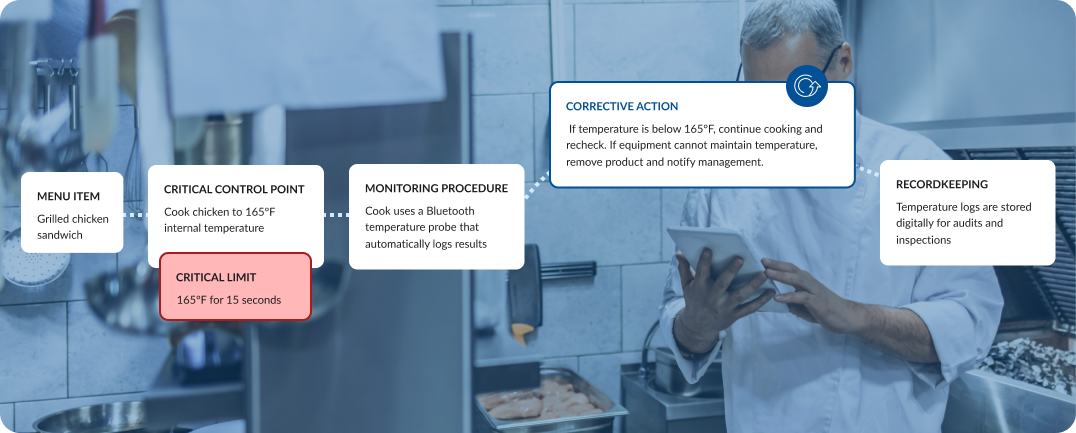
For example, chicken must reach an internal temperature of 165°F to eliminate Salmonella risk.
Clear limits help employees understand exactly what is required to keep food safe.
4. Establish monitoring procedures
CCPs must be monitored consistently to confirm critical limits are being met.
Restaurants should create routines for checking cooking temperatures, cold holding units, sanitizer concentrations, and other food safety controls.
With manual logs, checks are often missed, backfilled, or difficult to verify. Digital HACCP systems provide real-time visibility into completed tasks, helping operators confirm checks were actually performed, when they were completed, and by whom.
Assigning responsibilities, schedules, and digital verification steps helps improve accountability and consistency.
5. Establish corrective actions
When a food safety issue occurs, employees need clear instructions on how to respond.
Corrective action procedures should define:
- What action should be taken
- Who is responsible
- How the issue should be documented
Training staff on corrective actions is an important part of maintaining a reliable HACCP system.
6. Establish verification procedures
Verification activities confirm that the HACCP plan is working as intended.
Restaurants should regularly review logs, complete self-assessments, and verify that food safety procedures are being followed across shifts and locations.
Consistent verification supports stronger operational discipline and helps identify gaps before they become larger issues.
7. Establish recordkeeping and documentation procedures
Restaurants need organized records that document hazard analyses, monitoring activities, corrective actions, and verification procedures.
Detailed records are essential for inspections, third-party audits, and internal reviews. They also demonstrate that food safety controls are consistently followed.
Paper records can be difficult to organize, store, and retrieve when teams need them quickly. Digital and cloud-based HACCP systems simplify record access by centralizing logs, corrective actions, and verification history in one place, making audits and inspections easier to manage.
Benefits of digital HACCP systems
Digital HACCP systems help restaurants improve consistency, reduce manual work, and gain better visibility into daily food safety operations. Instead of relying on paper logs and disconnected processes, restaurant teams can monitor compliance in real time and respond to issues faster.
Some of the biggest benefits include:
1. Increased productivity
Manual checks and paperwork consume time across every shift for every employee.
Digital HACCP systems help restaurants reclaim those labor hours by automating documentation and reducing manual data entry. That allows staff to spend more time focused on customer-facing operations and running the restaurant.
Managers can also review logs, identify issues, and access records more efficiently without sorting through paper forms.
2. Better compliance
Paper checklists make it difficult to confirm whether tasks were completed correctly or on time.
Digital systems create time-stamped records tied to specific users, helping improve accountability and reduce incomplete checks.
3. More visibility across locations
With paper records, managers often need to be on site to review performance.
Digital systems allow restaurant and field leaders to monitor compliance remotely across multiple locations.
4. More reliable data
Paper logs only capture limited snapshots throughout the day.
Connected sensors and digital monitoring tools provide continuous data that gives operators a more complete view of food safety performance.
5. Faster issue detection
Digital monitoring systems can alert staff when temperatures or other conditions move outside acceptable ranges.
This allows teams to respond earlier before issues escalate.
6. Easier record access and storage
Paper files require physical storage and can easily become disorganized or damaged.
Cloud-based systems simplify record retrieval and improve long-term record management.
How to create an HACCP plan for your restaurant
An effective HACCP plan should be practical, repeatable, and easy for restaurant teams to follow during daily operations. The goal is to build a system that helps staff identify risks early, respond consistently, and maintain accurate records across every location.
The following steps can help restaurants build and standardize an HACCP plan:
Build your team
Include restaurant leadership, kitchen management, and food safety or QA personnel where applicable.
Map the process
Document the full workflow for key menu items, including receiving, storage, preparation, cooking, holding, and service.
Identify hazards and CCPs
Use the HACCP principles to identify where food safety risks exist and where controls are required.
Define monitoring tasks
Turn each CCP into a defined task such as line checks, temperature logs, or sanitizer testing.
Set escalation procedures
When a task fails, the system should trigger corrective actions and notify the appropriate team members.
Train and verify
Test the process, review exceptions, and adjust procedures as needed.
Standardize across locations
Once finalized, apply the same HACCP procedures, frequencies, and forms across all restaurants.
Improving restaurant HACCP processes with CMX1
Executing a HACCP plan consistently across multiple restaurants is difficult, especially when teams rely on manual processes and paper records.
Digital HACCP systems help operators improve consistency, increase visibility, and strengthen food safety execution across locations.
With the CMX1 platform, operators can author and distribute HACCP plans and SOPs, manage line checks and corrective actions, and maintain audit-ready compliance records from one centralized system. This helps restaurant brands maintain stronger operational control while supporting food safety and quality standards.
For restaurants looking to move away from paper logs and disconnected systems, digitizing HACCP processes can improve accountability, simplify audits, and help teams respond to issues faster.
Download our free HACCP eBook to learn more about the benefits of digital HACCP systems and how restaurant brands are modernizing food safety operations.
Frequently asked questions
What is the goal of HACCP?
HACCP is a structured approach for identifying, evaluating, and controlling food safety hazards.
The goal is to prevent food safety risks through consistent monitoring and process controls.
What are the seven principles of HACCP?
- Conduct a hazard analysis
- Determine critical control points
- Establish critical limits
- Establish monitoring procedures
- Establish corrective actions
- Establish verification procedures
- Establish recordkeeping and documentation procedures
Where does HACCP fit into restaurant food safety management?
HACCP is the foundation of restaurant food safety programs, but it works alongside prerequisite programs such as sanitation, personal hygiene, supplier management, and allergen controls.
Digital platforms help restaurants manage all of these programs in one place while maintaining audit-ready records.
When was HACCP developed?
HACCP was originally developed through a collaboration between NASA, Pillsbury, and the U.S. Army Laboratories to support safe food production for space missions.
In 1993, Codex Alimentarius published official HACCP guidelines. Today, HACCP principles are widely used around the world to improve food safety and traceability.