


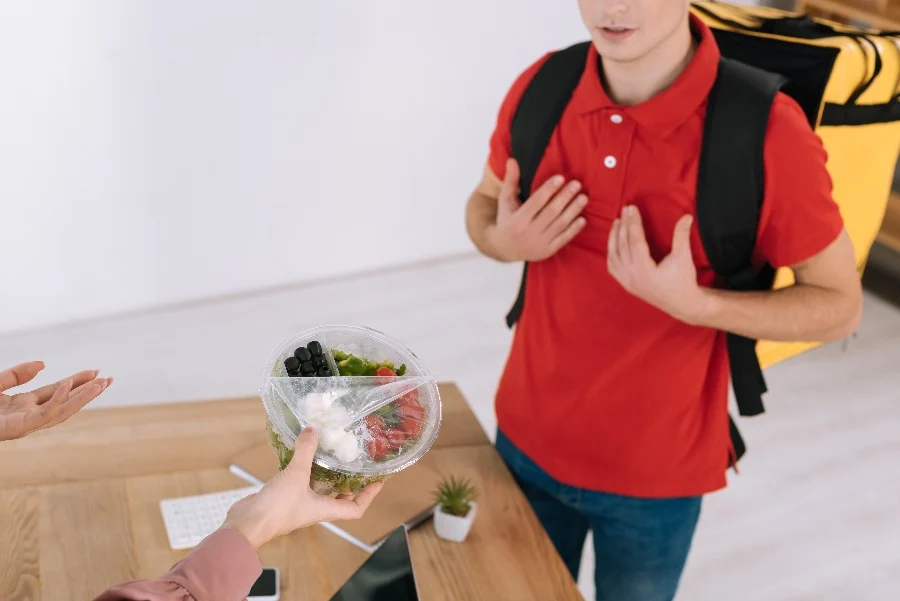
In our previous article, we introduced the concept of expanding HACCP beyond the doors of your retail food establishment. We gave a few reasons why your brand should still own the responsibility for food safety even when using third-party delivery services. We also concluded that not much regulation currently exists to hold these service providers accountable (except in California). In this article, we want to have a look at what exactly third-party food delivery companies are already doing to ensure food safety. But first…
Why the friction between restaurants and third-party delivery services?
Over the past few years, many foodservice establishments have fought back against third-party delivery services. With the COVID-19 outbreak, many restaurants had to rely on third-party delivery services due to closed seating areas. Jimmy John’s, for instance, promises their customers faster service, fresher food, and better value, and therefore refuses to use third-party delivery services. Dominos feels the same way, and use their own drivers to retain control and maintain quality. And it’s no wonder that restaurants don’t see eye to eye with these companies. According to the Wall Street Journal, food delivery apps can charge upwards of 30% in some cases! In order to cushion the effect of commission fees charged by these delivery services, several cities placed a cap on allowable commission fees. But while the issues have mostly been related to food quality and high commission fees, it’s only now in a worldwide pandemic that the food safety aspect in delivery has really gotten its deserved attention.
How to ensure safe food during delivery
The COVID-19 pandemic doubled the use of third-party food delivery apps. While many retail food establishments might have been hesitant to make the connection between digital technology and food safety, COVID-19 has forced them to pivot their operations and take another look at technology partners. A previously unknown landscape has now become an area of exploration in the effort to provide customers with safe food and great customer service. This is of course remains a challenge if you don’t have control over the way food is treated by your third-party service providers.
What are third-party delivery services doing for food safety?
Delivery companies (and delivery drivers) are often not necessarily trained in the same strict food safety principles as food workers, which could lead to potential hazards. While it’s certainly possible that a customer will associate a bad food experience with your brand rather than the actual food delivery company, many of these companies are still committed to food safety. The U.S. Food and Drug Administration (FDA) published the Food Code which gives retail food establishments and restaurants a set of guidelines to follow in order to keep food safe. Food delivery companies can (and should) use these same standards as a guideline to ensure food safety.
While delivery companies have no control over the actual food items, as these are provided by the retail food establishments, they can apply proper food safety practices by focusing on the two major food safety risks in delivery: maintaining a safe temperature and preventing contamination.
Safe Temperatures for Delivery
Food should be delivered as quickly as possible, to avoid the potential of the food danger zone. Some companies make use of insulated thermal liners or refrigerants to deliver TCS foods (foods that need time and temperature control for safety). Frozen foods should be kept frozen at 0°F or below, cold foods at 41°F or below, and hot (ready-to-eat) foods at 135°F or higher. Once TCS foods go out of these temperature zones, there’s a risk for foodborne bacteria to grow. This is where insulated delivery bags and coolers become useful to maintain safe temperatures.
Food Handling Practices
The same standard operating procedures (SOPs) that are implemented in restaurants and retail food establishments can also be used by food delivery companies. The most important of these is hand washing. The CDC recommends washing hands with soap and water for at least 20 seconds. For delivery drivers, this could be a logistical difficulty, but they can also use an alcohol-based sanitizer containing at least 60% alcohol.
Packaging
Besides insulated delivery boxes, it’s a good idea to make use of tertiary packaging to keep food upright and avoid spillage during transportation. This will also prevent physical damage and environmental contamination. Unlike primary packaging used by the retail food establishment or restaurant, the tertiary packing should be cleanable in order to be reused.
Clean vehicles
Many food delivery drivers use their own vehicles for delivery. It’s important that all vehicles used in the transportation of food are kept clean and free from odors, animal hair, and other debris. It’s the delivery company’s responsibility to make sure that the drivers have guidelines on how to properly clean and maintain their vehicles.
With the arrival of COVID-19, consumers have become more mindful of potential contamination and therefore food delivery companies have implemented several measures to prevent a food safety (or coronavirus) hazard. And while regulatory bodies have identified several risks associated with food delivery and give guidelines for third-party delivery companies to follow (and some follow these diligently), they’ve been slow to implement the necessary legislation and oversight needed.
Third-party food delivery companies should consider the use of tools like CMX1’s PoliciesX1 and AuditsX1 to perform their own hazard analysis, set up policies and procedures, perform inspections, and apply their own adaptation of Process HACCP. They can also use these tools to perform inspections on drivers, vehicles, and audits on general food safety and operational practices.
If you’re already using AuditsX1, you can easily create additional food safety transportation standards, and digital checklists or inspections to control potential hazards that may arise through the delivery process.
Want to learn more? Be sure to check out the articles in this series:
- With Food Delivery, Who’s Responsible for Food Safety? (Article 1)
- How to Maintain Food Safety if You’re Using a 3rd Party Delivery Service (Article 3)