



The 7 principles of HACCP are the foundation of every effective food safety program, but knowing them isn’t the same as consistently executing them. For operators managing multiple locations, the real challenge is turning those principles into repeatable routines that teams actually follow.
In this blog, we’ll break down each principle in plain terms. Then we’ll show how to operationalize them with standardized workflows, real-time monitoring, and verifiable records—so you’re not just checking boxes, you’re proving control.
Quick reference: The 7 HACCP principles
The 7 principles of HACCP are designed to be applied in sequence. Together, they create a closed-loop system for identifying hazards, controlling risk, and proving food safety.
Here’s a quick breakdown:
- Conduct a hazard analysis - Identify where food safety hazards could occur in your process
- Determine Critical Control Points (CCPs) - Pinpoint the steps where controls are essential to prevent or eliminate hazards.
- Establish critical limits - Define the measurable thresholds (e.g., time, temperature) that must be met
- Establish monitoring procedures - Set up how you’ll consistently check that critical limits are being met
- Establish corrective actions - Define what happens when something goes out of spec
- Establish verification procedures - Confirm that your HACCP system is working as intended
- Establish record-keeping and documentation - Keep clear, auditable records to prove compliance and performance
What is HACCP?
Hazard Analysis and Critical Control Points (HACCP) is a preventive method for managing food safety. It’s a central component of a proper food safety management system and applies to all stages of the food chain, from start to finish.
The mission of HACCP is simple: to provide a systematic approach to food safety that prevents and eliminates physical, biological, chemical, and radiological food safety hazards. These hazards not only harm customers but also cause irreparable damage to a brand due to the loss of customer trust.
To put another way, the HACCP system is the process you follow to predict hazards, control them at key points, and prove you did it.

What are the 7 principles of HACCP?
The 7 principles of HACCP were established in the 1990s, and although food industries have changed dramatically since then, the principles remain as relevant as ever.
Below, we’ll review them in detail and explain why each one is essential so that you can prepare and implement HACCP principles into your food safety system.
HACCP Principle 1 - Conduct a hazard analysis
The first principle of HACCP involves conducting a hazard analysis: preparing a list of steps in the process where significant food safety hazards occur and describing the preventive measures you plan to implement.
The goal of this principle is two-fold:
- Identify potential food safety hazards that might harm consumers
- Define preventative measures that will reasonably control these hazards
The first step in creating a HACCP plan is to perform a hazard analysis and identify suitable control responses. But what exactly is a hazard? The FDA defines a hazard as “...a biological, chemical, or physical agent that is reasonably likely to cause illness or injury in the absence of its control...”
It’s important to distinguish between safety and quality. In this process, a hazard is linked to safety concerns and not quality concerns. This principle focuses on hazards that are reasonably likely to occur in any of the following:
- Ingredients
- Raw materials
- Steps in the food production process
- Product storage
- Product distribution
- Final food preparation
A comprehensive hazard analysis is imperative for a HACCP plan to work, but what’s considered a hazard in one retail location may not be significant in another. Failure to identify any potential hazards, however, could render the entire HACCP system useless, regardless of how rigorously it is adhered to.
HACCP Principle 2 - Determine critical control points (CCPs)
According to the FDA, a critical control point (CCP) is: “...a point, step, or procedure in a food process at which control can be applied and is essential to prevent or eliminate a food safety hazard or reduce such hazard to an acceptable level...”
There are different types of CCPs within a process, but they all have the same purpose: to eliminate the risk or reduce it to an acceptable level. Examples of CCPs include:
- A thermal process (with time and temperature limits) designed to destroy a specific microbiological pathogen
- Sanitation standard operating procedures (SSOPs)
- Recognizing and identifying high-risk TCS (temperature control for safety) foods
- Storage specifications (e.g., maintaining refrigeration temperature below a certain limit) to avoid growth and multiplication of hazardous microorganisms
- pH adjustments of foods to prevent toxin formation
Going through the process, many find it difficult to determine whether a step is a critical control point. If a food safety hazard is likely to occur once control is lost at that step, then it is potentially a CCP.
HACCP Principle 3 - Establish critical limits
Once CCPs are identified, your team needs to establish critical limits (maximum or minimum values) to maintain a safe environment and to prevent, eliminate, or reduce food safety hazards to an acceptable level.
Critical limits must be based on scientific factors, guidelines, regulatory standards, experts, or experimental results. They include factors such as:
- Humidity
- pH
- Salt concentration
- Sensory information like visual appearance and smell (note that specialized training is necessary for this factor to be used successfully)
- Temperature/time
- Viscosity
- Water activity
HACCP Principle 4 - Establish monitoring procedures
Monitoring procedures are conducted to ensure that all critical limits are met and that food is indeed safe. It provides you with an early warning should your process trend towards loss of control.
Ideally, this process is continuous and done electronically. Doing this will ensure increased accuracy, control, and visibility over the process, compared to doing it intermittently and manually. It also provides documentation for later verification.
Monitoring a CCP is an important responsibility. Employees should be properly trained on the “why” and the “how”. Once employees understand the impact of food safety hazards (e.g., outbreaks, product recalls, business closure, job losses, etc.), they are more likely to get on board with the HACCP plan. Make sure that all employees (including senior management) are clear on:
- WHO will do the monitoring
- WHAT is being monitored
- Why is it being monitored
- WHEN will it be done (i.e., frequency)
- HOW it should be recorded
- WHERE these records should be kept
To accurately monitor critical limits, equipment and instruments must be calibrated and validated regularly. For multi-location operators, consistency is just as important as accuracy. Standardizing how monitoring is performed—across every store, shift, and team—ensures that data is captured the same way every time. This often means digitizing checklists and temperature logs so every location follows the same process and records data in a consistent format.
With built-in IoT integrations, teams can also automate data collection from Bluetooth probes and sensors, reducing manual effort, improving accuracy, and providing real-time visibility into potential risks before they become failures.
HACCP Principle 5 - Establish corrective actions
Undoubtedly, deviations will occur. Once a critical limit is exceeded, it’s vital to take corrective actions immediately. There are two types of corrective actions: immediate (or reactive) and preventive (proactive).
Immediate corrective action could mean throwing out food that has been in the temperature danger zone or sending home an employee who shows signs of illness.
Preventative corrective actions, on the other hand, could include repairing broken equipment or providing employees with proper food safety training.
HACCP Principle 6 - Establish verification procedures
Once you have your HACCP plan in place, you need to make sure it works correctly. Verification can involve any activity, other than monitoring, that tests the efficacy of the HACCP plan and ensures it's working as intended. This verification involves two primary aspects:
- Evaluating the HACCP system – This component confirms that the retail location or facility’s food safety procedures are properly functioning in conjunction with the HACCP plan. It shouldn’t rely on end-product testing; rather, it should depend upon frequent reviews of the HACCP plan itself, particularly of the CCP monitoring and corrective actions.
- Initially validating the HACCP plan for its technical and scientific merits – In other words, you can demonstrate that the implementation of your HACCP plan will actually reduce or eliminate the identified food safety hazards.
This can be done in several ways, including:
- Reviewing scientific literature (e.g., previous studies that showed time/temperature combinations ensure the elimination of certain microorganisms)
- Microbiological testing done on final products, produced under your HACCP plan (to show its efficiency)
- Information from regulatory bodies
According to the UK Food Standards Agency, practical examples of verification procedures include:
- Taking temperature measurements at different steps of the process, ensuring that it is at the level you expect it to be
- Testing product samples during and after production, to ensure microbiological and chemical safety
- Ensuring that suppliers of raw materials adhere to food safety principles by means of external audits
HACCP Principle 7 - Establish recordkeeping and documentation procedures
It’s of vital importance to maintain proper records for all aspects of the HACCP system, particularly for auditing purposes. It allows you to keep track of raw materials, process operations, and finished products in your establishment. You will also be able to identify potential problem areas where deviations might occur. You should keep a record of the following:
- A written hazard analysis summary
- The HACCP plan, including:
- Core team
- Assigned roles and responsibilities
- Description of the product, intended use, and consumer
- Flow diagram
- CCPs (how CCPs were selected, as well as the critical limits for each)
- Hazards likely to occur during the process
- Monitoring and verification procedures
- Corrective actions
- Documentation procedures
- Secondary or support documentation
- Documentation that occurs during the plan’s implementation and continued execution
For restaurants, hotels, ghost kitchens, and other retail food service establishments it’s critical to establish a checklist and operational routines for each daypart and shift throughout the week to ensure your HACCP system and procedures are being followed. Continually verifying your HACCP system establishes and maintains “Active Managerial Control” and a culture of “Operational and Quality Excellence” that reinforces expected behaviors.
Digitizing HACCP with CMX1
Successfully applying the 7 principles of HACCP is a significant undertaking for any food, beverage, or hospitality brand—especially at scale. For most organizations, the shift to digital has already happened. The challenge now is making those systems consistent, actionable, and audit-ready across every location.
CMX1 helps operationalize HACCP by connecting your routines, quality standards, and food safety programs in one place. Instead of disconnected tools and reactive processes, teams get structured workflows, real-time visibility, and built-in accountability. The platform enables you to:
- Standardize policies and procedures (Principles 1 & 2) - Digitize hazard analyses and CCPs so every location follows the same, approved processes
- Define and enforce critical limits (Principle 3) - Embed thresholds for time, temperature, and other variables directly into workflows
- Automate monitoring and improve data accuracy (Principle 4) - Replace manual logs with digital checklists and IoT integrations for consistent, real-time data capture
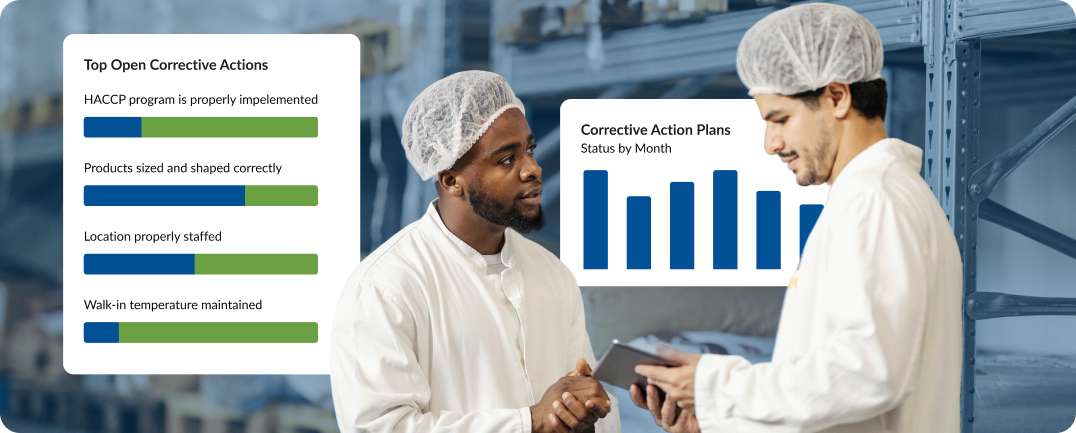
- Trigger and track corrective actions (Principle 5) - Automatically flag deviations and guide teams through the right response in the moment
- Verify performance across locations (Principle 6) - Gain visibility into trends, exceptions, and execution to ensure your HACCP plan is working as intended
- Maintain audit-ready records (Principle 7) - Centralize documentation so you can quickly prove compliance and operational control
Because CMX1’s compliance software connects policies, checklists, incidents, supplier data, and audits in one place, brands can show evidence of every HACCP principle in a few clicks, which is what regulators and brand‑protection teams want.
Our HACCP eBook distills these principles into action items that teams actually follow—and shows how to build a food safety culture around them. From daily routines and accountability to training and visibility, it connects the principles to the behaviors that drive consistency at every location. You’ll also see how well-known restaurant brands modernized their programs and what operational changes resulted. Grab the guide here.
Frequently asked questions
How do I apply the 7 HACCP principles across multiple locations?
Standardize your hazard analysis and CCPs first, then digitize monitoring so that every location captures the same data in the same format. That way, QA can review exceptions rather than chase paperwork.
What’s the difference between HACCP and prerequisite programs (PRPs)?
PRPs (such as sanitation, supplier approval, pest control, and employee hygiene) create the baseline environment. HACCP sits on top of that and controls the specific food safety hazards in your process.
Which HACCP principle gives operations leaders the fastest win?
For most brands, it’s Principle 4 (monitoring) because digitizing checklists, temperatures, and opening/closing routines immediately reduces missed checks and gives visibility by location.
How does HACCP connect to brand protection and recalls?
Good record‑keeping (Principle 7) lets you show regulators, franchisees, and your insurer that monitoring happened, limits were met, and corrective actions were taken. This shortens audits and investigations.
Can HACCP be integrated into CMX1?
Yes. CMX1 can host your HACCP plan, convert monitoring into guided digital tasks, alert on failures, and store all records in one place for audits.