


If food safety programs are built on standards and execution, recordkeeping is what proves they’re working.
Every temperature check logged, corrective action documented, and audit completed creates a clear, traceable record of performance. These records reflect how consistently teams are managing risk day to day, offering a reliable view into what’s happening across operations. When documentation is incomplete or inconsistent, it becomes harder to verify performance, respond to issues, and sustain improvement over time.
Recordkeeping and reporting play a central role in building accountability. They give leaders the visibility needed to confirm that standards are being followed, identify gaps early, and support continuous improvement across every location.
In this final part of our food safety culture series, we’ll explore how effective recordkeeping and reporting transform food safety from a reactive exercise into a proactive, data-driven discipline.
Why recordkeeping & reporting are crucial
In many organizations, recordkeeping is still treated as a back-office requirement—something done to satisfy auditors or regulators. But in high-performing food safety cultures, it plays a much bigger role.
Accurate, timely records help teams:
- Demonstrate compliance with HACCP-based programs
- Identify trends and recurring issues
- Validate that critical control points are being managed
- Respond quickly to incidents or deviations
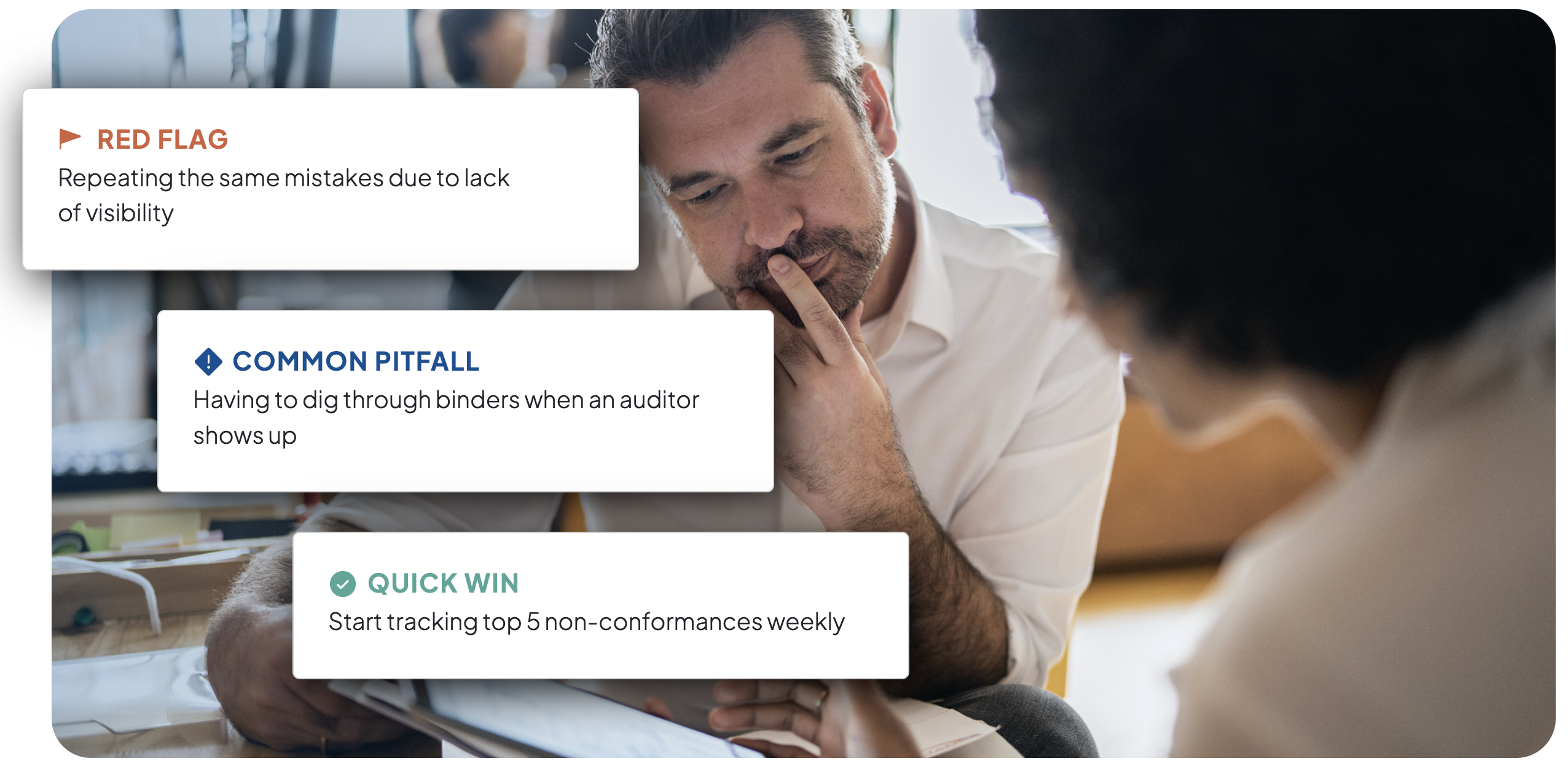
When records are incomplete, delayed, or inconsistent, those capabilities disappear. Leaders are left guessing. Small issues go unnoticed. And when an audit or incident occurs, teams scramble to reconstruct what should already be clear.
Strong reporting ensures that data is actionable. It turns daily activities into insights that drive better decisions at every level of the organization.

Common recordkeeping gaps to watch for
Even organizations with defined food safety programs often struggle with recordkeeping in practice. The most common challenges include:
- Incomplete or missed records due to manual processes or time constraints
- Paper-based systems that limit visibility and slow down reporting
- Inconsistent documentation across locations or teams
- Delayed corrective actions that aren’t tracked to completion
- Data silos that prevent enterprise-wide insights
These gaps are rarely intentional. More often, they reflect systems that make documentation harder than it should be—or processes that aren’t fully embedded into daily operations.
A strong food safety culture removes that friction.
What effective recordkeeping looks like
To support both compliance and safety culture, recordkeeping systems need to do more than capture information. They need to support how teams actually work.
Key requirements include:
- Real-time data capture at the point of activity
- Standardized documentation across all locations
- Clear audit trails for every check and corrective action
- Accessible reporting for both site-level and enterprise teams
When these elements are in place, recordkeeping becomes a natural extension of operations—not a separate task to complete later.
Just as importantly, it builds trust. Leaders can confidently answer questions like:
- Are food safety checks happening consistently?
- Where are we seeing the most risk?
- Are issues being resolved quickly and effectively?
How to strengthen recordkeeping & reporting
Strengthening recordkeeping and reporting starts with aligning processes to the realities of daily operations. The goal is to make documentation consistent, timely, and easy to complete—so it supports execution instead of slowing it down.
1. Make documentation part of the workflow
Recordkeeping should occur simultaneously with the task. By integrating documentation into line checks, temperature readings, and sanitation steps, the process remains quick and simple.
When teams are expected to remember and record later, accuracy drops, and gaps increase.
2. Standardize what “complete” looks like
Consistency is critical. Every location should document the same data, in the same way, at the same frequency.
That includes:
- What needs to be recorded
- When it needs to be recorded
- How corrective actions are documented
Standardization ensures that data can be compared, analyzed, and trusted across the organization.
3. Prioritize real-time visibility
Leaders shouldn’t have to wait for reports to understand what’s happening in the field. Real-time visibility allows teams to catch missed checks, overdue tasks, or emerging risks as they happen.
That shift—from delayed reporting to immediate insight—is what enables proactive management. In fact, the limitations of manual, delayed reporting are often what push organizations to adopt digital solutions in the first place. When data is captured and shared in real time, teams can move faster, respond sooner, and manage food safety with greater confidence.
4. Close the loop on corrective actions
Documenting an issue is only the first step. Strong systems ensure that corrective actions are assigned, tracked, and verified.
Without closure, the same issues tend to repeat, undermining both compliance and culture.
5. Turn data into actionable insights
The most effective organizations transform their collected data into actionable results.
By analyzing trends across locations, teams can:
- Identify recurring problem areas
- Improve training programs
- Refine operational standards
- Recognize high-performing sites
This is where recordkeeping evolves into a strategic advantage.
How CMX1 supports recordkeeping & reporting
Strong recordkeeping becomes even more powerful when it’s paired with reporting that turns data into action.
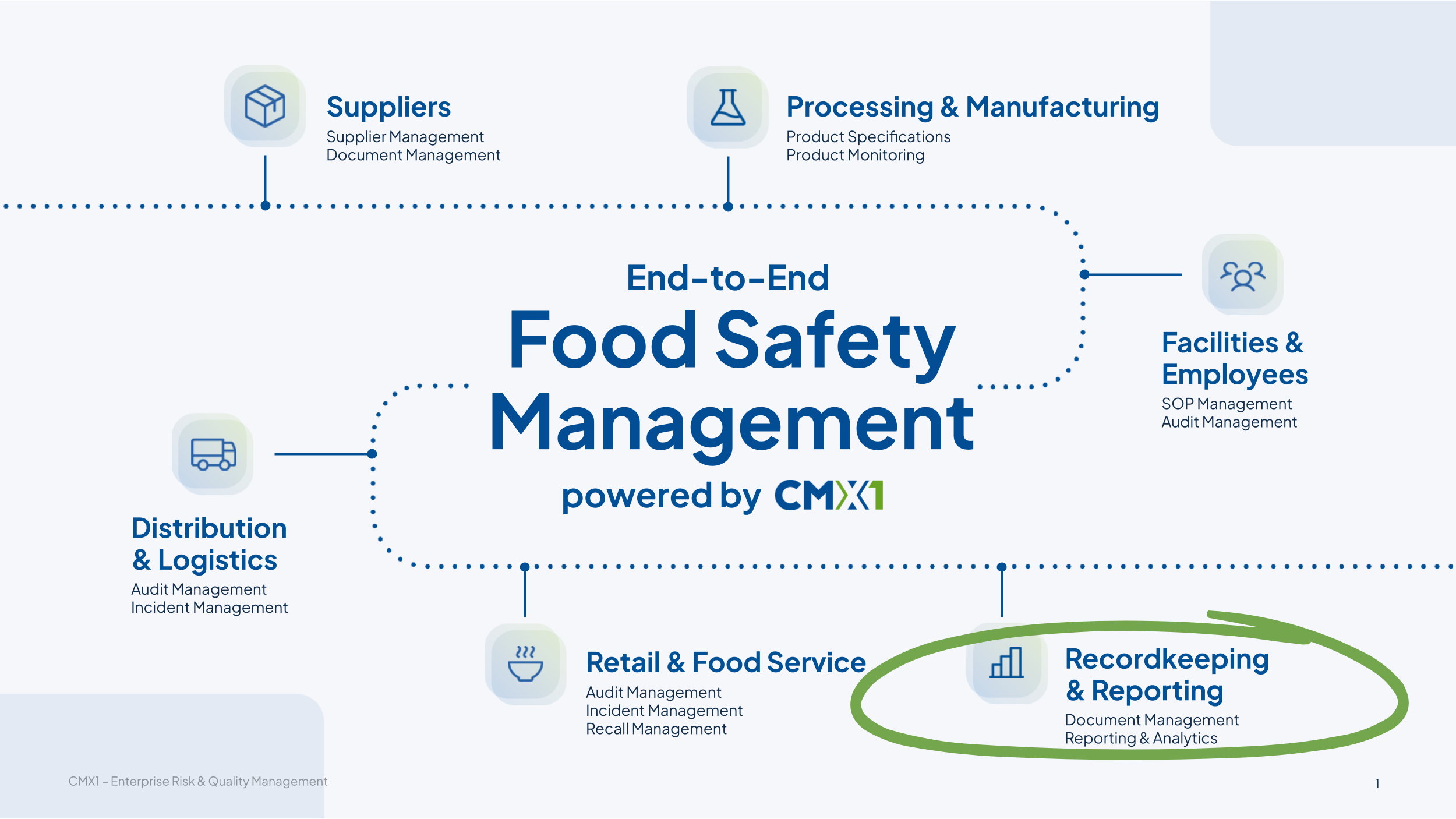
CMX1’s reporting capabilities give organizations a clear, real-time view of performance across all locations. By centralizing data into a single source of truth, teams can quickly understand what’s happening in the field without chasing down spreadsheets, emails, or paper records. This all-in-one approach improves visibility and elevates how teams manage food safety across the organization.
With configurable dashboards and data visualization tools, leaders can track key metrics like completed activities, recurring issues, and corrective action status at a glance. This makes it easier to identify trends, compare performance across regions or locations, and focus attention where it’s needed most.
CMX1 also supports deeper analysis through integrated business intelligence (BI) reporting, allowing teams to explore data in more detail, uncover root causes, and make informed, data-driven decisions at every level of the organization.
This centralized approach also eliminates hours of manual data consolidation, freeing teams to focus on addressing risks, resolving issues, and improving performance in real time.
The result is a more connected approach to food safety, where insights are easy to access, performance is easy to measure, and continuous improvement becomes part of everyday operations.
The power of proof in food safety culture
Food safety culture depends on consistently doing the right things—and having the records to demonstrate it across every day and every location.
Recordkeeping and reporting provide that proof. They turn daily actions into a clear, reliable picture of performance. And they give organizations the insight needed to continuously improve.
In the end, a strong food safety culture transforms trust into certainty through tangible evidence.
Ready to strengthen your food safety culture from the ground up? Download CMX1’s Food Safety Culture Guide to discover practical strategies to improve visibility, ensure compliance, and turn food safety into a measurable, data-driven advantage.